
English 
Views: 0 Author: Site Editor Publish Time: 2026-09-23 Origin: Site
A wrong specification can delay production and increase equipment costs.
What details should buyers confirm before ordering?
A PVC wall panel production line depends on product size, material, capacity, and finishing requirements.
In this article, we will discuss the 8 key specifications buyers should prepare before requesting a quotation.
Before selecting equipment, buyers should clearly define what type of PVC wall panels they plan to produce. Different panel structures require different extrusion designs, molds, and downstream equipment.
A PVC wall panel production line can be used for various products, including decorative wall panels, hollow panels, WPC wall panels, ceiling panels, and UV marble sheets. Each product has different requirements for thickness, surface appearance, material formulation, and production process.
For example, a lightweight hollow wall panel may require a different calibration system compared with a high-gloss decorative panel. A UV marble sheet production line may also need additional surface treatment equipment to achieve the required visual effect.
Buyers should prepare the following product information:
Panel type and application
Product drawings
Panel width and thickness
Surface design requirements
Indoor or commercial usage
Providing these details allows suppliers to understand the actual production target and recommend suitable equipment configurations.
KS Bonzer provides customized extrusion solutions for different plastic processing requirements. Buyers can review available equipment options through the company’s PVC extrusion production solutions.
Production capacity is one of the most important factors when requesting a quotation. A machine designed for small-scale production may not meet high-volume manufacturing needs. At the same time, oversized equipment can increase investment costs and energy consumption.
Suppliers usually need to know the expected output before selecting the extruder size, motor power, and auxiliary equipment. Buyers should consider:
Daily production requirements
Working hours per day
Required output speed
Future expansion plans
Production capacity is usually measured by weight output or production speed. For example, buyers may provide requirements based on kilograms per hour or meters of finished panels per hour.
The required output directly affects the main equipment configuration. A higher production target may require:
Larger extruder capacity
More powerful drive systems
Improved cooling systems
Faster haul-off equipment
A clear production target helps suppliers balance machine performance and investment costs. It also prevents buyers from receiving quotations based on incorrect assumptions.
Material information is another key specification before purchasing a PVC wall panel production line. PVC panels can use different formulations depending on strength requirements, appearance, and application environment.
Common material factors include:
PVC resin type
Calcium carbonate content
Stabilizers and additives
WPC material composition
Recycled material ratio
Different formulations influence extrusion temperature, screw design, and processing stability. For example, PVC WPC panels contain wood powder or other composite materials, which may require different processing conditions compared with standard PVC panels.
Buyers should communicate material details clearly because they affect:
Extruder selection
Screw configuration
Production stability
Final product quality
Tip:Before requesting a quote, buyers should prepare product samples, drawings, and material formulas whenever possible. These details help suppliers design a more accurate production solution.
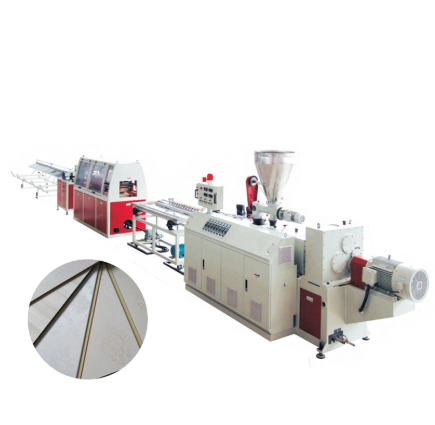
Product dimensions directly affect the design of the extrusion system. Even small differences in panel width or thickness can change the required mold structure and calibration equipment.
Before requesting a quotation, buyers should provide:
| Specification | Information Required |
|---|---|
| Panel width | Finished product size |
| Panel thickness | Required thickness range |
| Panel length | Cutting requirement |
| Surface design | Embossing or decorative pattern |
| Profile structure | Hollow or solid design |
The mold, vacuum calibration table, cooling system, and cutting unit must match the final panel dimensions. Incorrect size information may result in unsuitable equipment design.
For example, wider decorative wall panels usually require stronger extrusion capacity and larger calibration systems to maintain product stability.
The expected output helps suppliers determine the complete production line configuration. Buyers should provide realistic production targets based on current market demand and future growth plans.
Important information includes:
Hourly production capacity
Annual production volume
Number of production shifts
Expected operating time
A production line designed for continuous industrial manufacturing requires different components compared with a smaller factory setup.
Output requirements influence:
Extruder model
Motor power
Cooling capacity
Automatic cutting system
Stacking equipment
Clear output information also helps suppliers provide a more accurate quotation because the machine configuration can match actual production needs.
The extruder is the core component of a PVC wall panel production line. It controls material melting, mixing, and continuous extrusion.
Buyers should confirm:
Extruder type
Screw diameter
Motor power
Heating zone design
Temperature control system
Depending on the material and production requirements, suppliers may recommend different extrusion configurations. PVC materials often require stable processing conditions because temperature control and material mixing affect surface quality.
A suitable extrusion system helps achieve:
Stable material flow
Consistent panel thickness
Better surface finish
Reliable long-term operation
PVC wall panels are often used in interior decoration, so surface appearance has become an important purchasing factor. Different markets may require different finishes, including wood grain, marble patterns, matte textures, or high-gloss surfaces.
Before requesting a quotation, buyers should confirm the required decoration process, such as:
UV coating
Lamination film application
Printing process
Embossing pattern
Hot stamping
These requirements affect the configuration of the production line. For example, a standard PVC wall panel may only require extrusion and basic cutting equipment. However, a high-gloss UV marble panel may need additional coating and surface treatment systems.
A complete decorative process can improve:
Product appearance
Market competitiveness
Surface durability
Customer acceptance
Buyers should also provide samples or reference images if they have specific appearance requirements. This helps suppliers select suitable finishing equipment and avoid differences between the final product and market expectations.
Automation requirements should be confirmed before ordering a PVC wall panel production line because they directly affect operation efficiency and labor requirements.
Different factories may have different expectations for automation. Some manufacturers prefer basic manual operation, while others require highly automated production systems.
Important automation specifications include:
PLC control system
Automatic material feeding
Automatic temperature control
Automatic cutting
Remote monitoring functions
A higher automation level can help improve production consistency and reduce manual intervention. It is especially useful for factories producing large quantities of PVC panels.
However, automation level should match actual production needs. Excessive automation may increase investment costs without creating additional value for smaller production projects.
Buyers should discuss their expected workflow with suppliers and select a suitable balance between efficiency and investment.
Factory conditions are often overlooked during the early quotation stage. However, they directly influence installation and operation after delivery.
Before ordering, buyers should confirm:
Local power supply voltage
Factory installation space
Production area layout
Cooling water availability
Equipment transportation conditions
The power requirement depends on the selected machine configuration. Larger extrusion systems usually require higher electrical capacity and more stable power supply.
Factory space is also important because a complete PVC wall panel production line includes multiple units, such as:
Extruder
Calibration table
Cooling tank
Haul-off unit
Cutting machine
Stacker
A clear factory layout allows suppliers to design a suitable machine arrangement. It also helps reduce installation difficulties after the equipment arrives.
A complete production solution includes more than the main extruder. Auxiliary equipment plays an important role in material preparation, product shaping, cooling, and final handling.
Depending on production requirements, buyers may need:
| Equipment | Function |
|---|---|
| Mixing system | Prepares PVC materials |
| Feeding system | Provides stable material supply |
| Extrusion mold | Forms the panel profile |
| Vacuum calibration table | Controls product dimensions |
| Cooling tank | Reduces panel temperature |
| Haul-off unit | Maintains production speed |
| Cutting machine | Controls finished length |
| Stacker | Improves product handling |
The selection of auxiliary equipment affects the final quotation and production performance.
For example, a factory producing decorative panels for export markets may require more precise cutting and stacking systems compared with a small local manufacturer.
A supplier should evaluate the complete production process instead of only recommending the main extrusion machine.
Different markets may have different requirements for plastic processing equipment. Buyers should communicate these requirements before requesting a quotation.
Important considerations include:
Electrical standards
Safety requirements
Customer-specific specifications
Export documentation requirements
Certification requirements may influence component selection, electrical systems, and machine design.
For international buyers, confirming these details early helps prevent delays during shipment, installation, or market approval.
Tip:A complete quotation should include equipment specifications, production capability, and service support because successful production depends on the entire solution, not only the machine itself.
PVC hollow wall panels are widely used in interior decoration because they provide lightweight structures and efficient material usage. Their internal hollow design helps reduce material consumption while maintaining practical performance.
For hollow panel production, buyers should pay attention to:
Panel structure design
Thickness requirements
Extrusion stability
Calibration accuracy
Cooling performance
The production line must maintain accurate dimensions during continuous extrusion. Poor calibration may cause uneven thickness, deformation, or installation problems.
A suitable PVC hollow wall panel production line should provide stable processing performance and consistent product quality.
PVC WPC wall panels combine PVC materials with wood powder or other composite components. They are often selected for decorative applications that require natural appearance and improved surface texture.
Compared with standard PVC panels, WPC materials may require different extrusion conditions.
Important factors include:
Wood powder percentage
Material mixing quality
Screw design
Temperature control
Surface finishing requirements
Material composition affects melting behavior and extrusion stability. Therefore, suppliers need detailed information about the formulation before designing the equipment.
A suitable extrusion solution helps maintain:
Uniform material distribution
Stable output
Better surface appearance
Consistent product quality
UV marble sheets and decorative PVC panels usually focus on premium appearance. They require additional attention to surface treatment and finishing processes.
These products often require:
High-gloss surfaces
Decorative film application
UV coating
Scratch resistance
Visual consistency
The production line configuration may include additional finishing equipment after extrusion.
Buyers should provide clear information about:
Surface gloss requirements
Pattern design
Coating thickness
Decorative material type
This allows suppliers to recommend a suitable production process and avoid unexpected modifications later.
The extrusion system is the core part of a PVC wall panel production line. It determines how raw materials are processed and transformed into finished panels.
Buyers should confirm:
Extruder model
Screw and barrel design
Drive system
Heating zones
Temperature control method
Stable extrusion performance directly affects product quality. A properly designed extrusion system helps maintain consistent output and reduces material waste.
The main machine should match the material formulation and production target. A configuration designed for standard PVC panels may not be suitable for complex WPC or decorative products.
After extrusion, the panel must be shaped and cooled accurately. The calibration and cooling systems are essential for maintaining product dimensions.
Important components include:
Vacuum calibration table
Cooling tanks
Temperature control system
These systems affect:
Surface quality
Panel thickness accuracy
Product stability
Production speed
A well-designed cooling system helps prevent deformation and improves the final appearance of PVC wall panels.
The downstream equipment controls product movement and final sizing. It ensures that panels are produced at a stable speed and cut according to customer requirements.
Key factors include:
Pulling speed accuracy
Cutting precision
Automatic operation
Product handling method
Matching downstream equipment with extrusion speed helps improve production efficiency and reduce waste.
Choosing the right supplier is an important step before purchasing a PVC wall panel production line. A machine is not only a single piece of equipment. It is a complete production solution that requires engineering experience, manufacturing capability, and technical knowledge.
Buyers should review supplier experience in areas such as:
Plastic extrusion equipment manufacturing
PVC panel production projects
Customized machine design
International installation experience
Quality control procedures
An experienced supplier can better understand different product requirements. They can recommend suitable extrusion systems based on panel structure, material formulation, and production targets.
For example, a supplier familiar with decorative PVC panels may provide better suggestions for surface treatment and downstream equipment. A supplier experienced in WPC materials may offer more suitable screw designs and processing parameters.
Before making a decision, buyers should evaluate whether the supplier can provide complete technical support from machine design to production operation.
Every PVC wall panel manufacturer may have different production goals. Some focus on standard interior panels, while others produce customized decorative products for specific markets.
Therefore, customization capability is an important factor when comparing suppliers.
Possible customization requirements include:
Machine layout adjustment
Extruder configuration
Panel size compatibility
Production capacity changes
Automation upgrades
A flexible supplier can adjust the production line according to customer needs instead of providing a fixed solution.
For example, buyers producing multiple panel designs may require a production line that supports different molds and product structures. Companies targeting premium decoration markets may need additional surface treatment options.
A customized solution can help manufacturers improve production flexibility and adapt to changing market demands.
KS Bonzer provides extrusion equipment solutions designed around different customer requirements. Buyers can explore the company’s product range to understand available production equipment options.
Equipment delivery is only the beginning of a long-term production process. Technical support and after-sales service can directly influence production stability.
Before ordering, buyers should confirm whether suppliers provide:
Installation guidance
Machine operation training
Maintenance support
Spare parts supply
Technical troubleshooting
A reliable supplier should help customers solve problems during installation and daily operation.
For overseas buyers, remote technical support is especially important. Quick communication can reduce production downtime and help operators maintain stable output.
Tip:When comparing suppliers, buyers should evaluate service capability together with machine specifications. A lower equipment price may create higher costs if technical support is limited.
The price of a PVC wall panel production line depends on many factors. Buyers should not compare quotations only by the total price because different configurations may provide different production capabilities.
Main cost factors include:
Production capacity
Extruder specifications
Automation level
Surface treatment equipment
Auxiliary machines
Electrical components
A higher-capacity production line usually requires stronger motors, larger cooling systems, and more advanced control systems.
Similarly, decorative products such as UV marble sheets may require additional finishing equipment compared with standard PVC panels.
When reviewing quotations, buyers should compare the complete equipment list instead of only focusing on the initial investment.
A detailed quotation should clearly include:
| Item | Details to Confirm |
|---|---|
| Main machine | Extruder model and capacity |
| Auxiliary equipment | Complete production process |
| Automation system | Control functions |
| Installation support | Technical service |
| Spare parts | Long-term maintenance |
This approach helps buyers understand the real value behind each quotation.
The lowest quotation is not always the most suitable choice. A production line should provide stable operation, consistent product quality, and reasonable maintenance costs.
Buyers should evaluate long-term factors, including:
Energy consumption
Production efficiency
Equipment lifespan
Maintenance requirements
Product quality stability
A machine with better extrusion stability may reduce material waste and improve production efficiency over time.
For example, inaccurate temperature control or unstable material feeding can lead to defective panels. These problems may increase operating costs even if the initial machine investment is lower.
A better purchasing decision considers both current budget and future production benefits.
Market demand can change after the production line starts operation. Buyers should consider whether the equipment can support future business growth.
Important questions include:
Can production capacity be increased?
Can additional panel types be produced?
Can automation systems be upgraded?
Can new molds be installed?
A flexible PVC wall panel production line allows manufacturers to respond faster to market changes.
For companies planning long-term development, selecting equipment with expansion potential can provide better investment value.
Clear technical information helps suppliers understand customer requirements before preparing a quotation.
Without complete specifications, suppliers may misunderstand:
Product dimensions
Required output
Material type
Surface requirements
Automation expectations
This may result in repeated communication, quotation changes, or unsuitable machine recommendations.
Providing complete information allows suppliers to create a more accurate production solution from the beginning.
The quotation process becomes faster because both sides have a clearer understanding of the project.
A properly matched production line can improve manufacturing results.
Accurate specifications help ensure that:
The extruder matches the material
The mold matches product dimensions
Cooling systems match production speed
Cutting equipment matches product length
When each component works together, manufacturers can achieve:
Stable production output
Better panel quality
Lower material waste
Easier operation
This is especially important for factories producing large quantities of PVC panels.
A successful equipment purchase requires cooperation between buyers and manufacturers.
Clear technical communication helps both sides:
Confirm project requirements
Select suitable equipment
Reduce design changes
Improve delivery efficiency
A supplier that understands customer goals can provide more valuable recommendations during the purchasing process.
For international buyers, long-term cooperation with an experienced manufacturer can also provide continuous technical support after installation.
Before requesting a quotation for a PVC wall panel production line, buyers should prepare complete information about product dimensions, material requirements, production capacity, extrusion configuration, finishing process, automation level, and factory conditions.
Detailed specifications help suppliers design suitable equipment solutions and provide more accurate quotations. They also reduce purchasing risks and improve production performance after installation.
KS Bonzer offers customized extrusion solutions for different PVC panel manufacturing needs. With reliable equipment, technical support, and flexible production options, it helps buyers achieve stable output and long-term production value.
A: A PVC wall panel production line is equipment used to extrude, shape, cool, and finish PVC decorative panels.
A: Buyers should provide panel size, material type, output demand, finishing process, and automation requirements.
A: Proper machine configuration improves extrusion stability, panel accuracy, surface quality, and production efficiency.
A: Complete specifications help suppliers recommend suitable equipment and avoid incorrect configurations or extra costs.
A: The price depends on capacity, machine configuration, automation level, and required auxiliary equipment.


