
English ![]()

Views: 0 Author: Site Editor Publish Time: 2026-09-28 Origin: Site
Choosing the right production line can decide your WPC decking business success.
A wrong choice may increase costs and limit future growth.
A WPC decking production line should match material type, output demand, and product goals.
In this article, we will compare material options, production capacity, and co-extrusion solutions to help you make a better decision.
A WPC decking production line converts wood plastic composite materials into finished decking profiles through several continuous processes. The complete system usually includes material mixing, feeding, extrusion, shaping, cooling, surface treatment, cutting, and stacking.
Each production stage affects the final decking quality. Stable extrusion helps maintain profile strength, surface appearance, dimensional accuracy, and production efficiency.
During manufacturing, raw materials are first mixed according to the required formula. The prepared material then enters the extruder, where it is melted and plasticized under controlled conditions. After extrusion, the profile passes through calibration and cooling systems to achieve accurate dimensions.
The final steps include surface processing, cutting, and stacking. These processes determine the appearance and usability of the finished decking products.
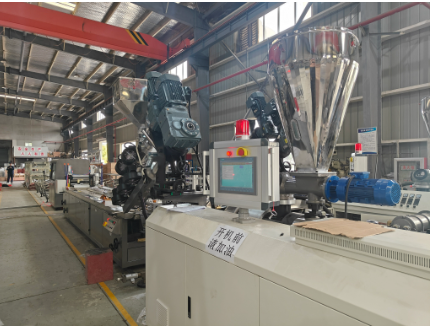
A complete decking extrusion system contains multiple units that work together. Common components include the extruder, die and mold, vacuum calibration table, cooling system, haul-off unit, cutting machine, and stacking equipment.
Each component has a specific role in maintaining stable production.
For example, the extruder controls material plasticizing performance. The die determines profile shape. The calibration system helps maintain size accuracy. Cooling equipment supports profile stability after forming.
When equipment is not properly matched, manufacturers may experience unstable output, higher waste rates, or inconsistent product quality.
The same WPC decking production line may require different configurations depending on material formula, decking size, production volume, and product application.
Before requesting quotations, buyers should define their target products first. This includes decking structure, surface design, expected capacity, and market positioning.
A supplier can only recommend a suitable solution after understanding these requirements.
Tip:Buyers should confirm decking material and target output first because these factors directly influence extruder design, motor power, and auxiliary equipment selection.
PE WPC decking is commonly used for outdoor applications because it provides good moisture resistance and impact performance.
However, different PE formulations require different processing conditions. Material composition affects extrusion temperature, screw design, and overall processing stability.
When selecting equipment, buyers should provide material information to suppliers. It helps engineers adjust extrusion parameters and create a more suitable production solution.
PE WPC decking lines are often selected for projects that require outdoor durability and stable performance under changing weather conditions.
PVC WPC decking offers higher rigidity and good dimensional stability. It is often used for decorative flooring and profile applications where shape accuracy is important.
Compared with PE materials, PVC formulas require careful plasticizing and temperature management during processing.
The extrusion system must provide stable processing conditions to maintain surface quality and profile consistency.
Manufacturers should consider PVC formulation, product structure, and finishing requirements before selecting equipment.
PP WPC decking provides lightweight characteristics and mechanical strength for specific applications.
Because PP materials have different processing characteristics, they may require different extrusion parameters.
Material selection directly affects machine configuration, production speed, and final product performance.
Buyers should compare material advantages based on application environment, product positioning, and customer requirements.
| Material Type | Main Features | Suitable Applications |
|---|---|---|
| PE WPC | Moisture resistance and durability | Outdoor decking |
| PVC WPC | High rigidity and stable shape | Decorative flooring and profiles |
| PP WPC | Lightweight and strong performance | Special decking applications |
The best material choice depends on climate conditions, usage environment, and target market.
Output capacity shows how much material a production line can process within a specific period. Buyers usually evaluate capacity through kg/hour output, daily production volume, working hours, and order requirements.
A higher output line can support larger orders, but it also requires higher investment and stronger factory support.
Capacity selection should match actual market demand instead of focusing only on maximum production numbers.
Small and medium manufacturers often prefer moderate output solutions because they provide flexible production scheduling and lower initial investment.
Large manufacturers usually require higher output equipment for continuous production, larger orders, and improved production efficiency.
However, higher capacity is not always the best option. If market demand is limited, oversized equipment may increase operating pressure.
Buyers should consider current orders and future growth plans before making a decision.
Output capacity affects labor efficiency, energy consumption, production cost per unit, and delivery capability.
A well-matched production line can improve resource utilization and reduce unnecessary operating costs.
Manufacturers should evaluate long-term value rather than selecting equipment only based on output figures.
Co-extrusion technology adds an additional protective layer to WPC decking profiles. This structure improves weather resistance, surface appearance, and durability.
It also allows manufacturers to create more decorative surfaces and different product designs.
For premium outdoor decking markets, co-extrusion can provide stronger product differentiation.
| Feature | Standard WPC Decking | Co-Extrusion WPC Decking |
|---|---|---|
| Surface layer | Single material structure | Additional protective layer |
| Appearance | Basic surface design | More decorative options |
| Protection | Standard durability | Enhanced outdoor resistance |
| Cost | Lower investment | Higher equipment investment |
Standard decking lines may suit cost-sensitive projects. Co-extrusion systems are better for manufacturers targeting premium products.
Co-extrusion equipment is suitable for premium outdoor decking, long-term outdoor projects, and high-end residential markets.
It can improve product value and help manufacturers compete in higher-end markets.
Tip:Co-extrusion equipment requires additional configuration, so buyers should confirm target product positioning before selecting this option.
Before ordering, buyers should confirm decking width, thickness, hollow or solid structure, surface texture, and length requirements.
These details influence die structure, calibration systems, and cooling requirements.
Accurate product information allows suppliers to prepare more suitable equipment recommendations.
Important specifications include extruder type, screw diameter, motor power, heating zones, and control system.
Stable extrusion performance directly affects output consistency, material processing, and product quality.
Buyers should confirm these technical details before comparing supplier quotations.
Different decking products may require different finishing methods, including embossing, brushing, co-extrusion layers, and surface textures.
Surface requirements influence machine configuration and production investment.
Manufacturers should define their final product appearance before selecting equipment.
Residential outdoor decking usually focuses on appearance, durability, and stable performance. Homeowners often require products that can maintain good surface quality under sunlight, rain, and temperature changes.
For these applications, manufacturers should consider:
Surface texture requirements
Weather resistance
Color stability
Dimensional accuracy
A suitable WPC decking production line should provide stable extrusion performance and accurate profile shaping. These factors help manufacturers produce decking boards that meet residential installation requirements.
For premium residential projects, co-extrusion technology can provide additional surface protection and improve product appearance. It allows manufacturers to create products with stronger visual appeal and better outdoor performance.
Commercial projects usually require larger production volumes and consistent product quality. Applications may include outdoor platforms, public walkways, landscape projects, and large construction developments.
These projects often require:
Higher production capacity
Stable continuous operation
Consistent profile dimensions
Reliable product supply
For manufacturers serving commercial markets, selecting a higher-output WPC decking production line can improve order fulfillment ability.
However, output capacity should still match actual demand. Excessive production capacity may increase investment and operating costs if market volume is not sufficient.
Some manufacturers produce customized WPC products instead of standard decking boards. These products may include special shapes, different colors, or unique surface designs.
Customized production requires more flexible equipment solutions.
Important factors include:
Adjustable extrusion parameters
Multiple tooling options
Flexible surface processing
Easy product changeover
A flexible production line allows manufacturers to respond to different customer requirements and expand product categories.
Tip:Manufacturers planning customized WPC profiles should confirm future product types before ordering because tooling flexibility can affect long-term production opportunities.
Supplier experience plays an important role in equipment selection. WPC decking production involves material processing, extrusion technology, tooling design, and downstream equipment coordination.
Buyers should review:
WPC extrusion experience
Previous customer projects
Engineering capability
Production technology
An experienced supplier can better understand the connection between material formulas, profile structures, and machine configurations.
This helps reduce risks during equipment selection and improves the possibility of achieving stable production after installation.
Different buyers have different production goals. Some manufacturers focus on standard outdoor decking, while others need customized profiles or premium co-extrusion products.
A capable supplier should provide support in areas such as:
Material testing
Production line design
Equipment configuration
Installation guidance
Operator training
Technical support is especially important for first-time buyers because extrusion equipment requires proper installation and adjustment.
Professional guidance can help manufacturers reduce commissioning time and improve production efficiency.
Purchasing a WPC decking production line is a long-term investment. Buyers should evaluate not only initial equipment costs but also future operation support.
Important factors include:
Spare parts availability
Maintenance support
Equipment upgrades
After-sales service
Reliable suppliers can help manufacturers maintain stable production over many years.
A complete service system improves equipment utilization and reduces unexpected downtime.
Tip:A supplier’s technical support capability is as important as equipment quality because stable production depends on installation, operation, and maintenance.
The best WPC decking production line depends on the manufacturer’s overall product strategy.
Before making a decision, buyers should evaluate:
Material selection
Output requirements
Co-extrusion needs
Target market
For example, a company producing standard outdoor decking may focus on stable output and cost control.
A manufacturer targeting premium markets may require co-extrusion technology, advanced surface treatment, and higher product customization.
Equipment investment should match expected production value.
Buyers should consider:
| Evaluation Factor | Why It Matters |
|---|---|
| Equipment cost | Determines initial investment |
| Production efficiency | Affects manufacturing capacity |
| Product value | Influences market positioning |
| Future expansion | Supports business growth |
A low-cost solution may not always provide the best return. Equipment should deliver stable operation, suitable output, and reliable product quality.
Manufacturers should compare complete production solutions instead of selecting equipment only by purchase price.
A properly matched WPC decking production line can improve production stability, reduce operating risks, and support business expansion.
Before ordering, buyers should think about future requirements, including:
New decking designs
Higher production demand
Additional surface technologies
Expanding customer markets
A flexible production system gives manufacturers more opportunities to adjust their products as market needs change.
Choosing the right WPC decking production line requires comparing material types, output capacity, and co-extrusion options. KS Bonzer provides reliable extrusion solutions with stable performance, flexible configurations, and professional support for different WPC decking manufacturing needs.
A suitable production line helps improve efficiency, product quality, and long-term production value.
A: A WPC decking production line manufactures wood plastic composite profiles through extrusion, cooling, and cutting processes.
A: Select based on material type, output demand, product design, and co-extrusion requirements.
A: Co-extrusion improves surface protection, appearance, and outdoor durability for premium decking products.
A: Capacity, machine configuration, automation level, and auxiliary equipment affect the total investment.


