
English ![]()

| Quantity: | |
|---|---|
Product Description
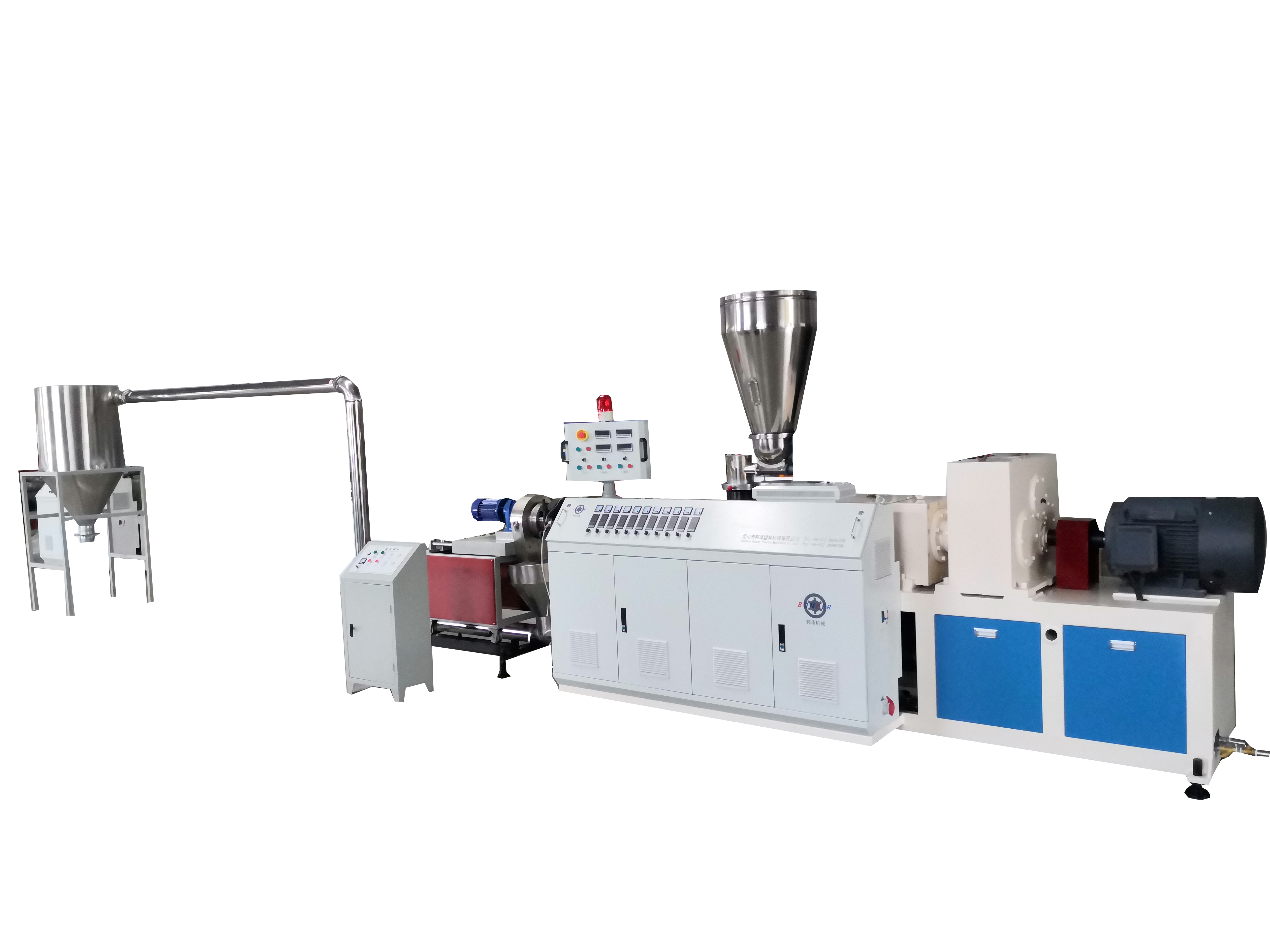
A PVC pelletizing extrusion line is designed to convert PVC compounds or recycled PVC materials into consistent, high-quality granules for further manufacturing. Depending on the production requirements, the line typically consists of a high-speed mixer, twin-screw extruder, strand die, cooling system, pellet cutter, and storage unit, forming a complete and efficient PVC granules production process.
During operation, PVC raw materials or recycled PVC scrap are plasticized and compounded in the extruder under controlled temperature and pressure. The molten material is then extruded into continuous strands, cooled in a water tank or air-cooling system, and precisely cut into uniform PVC pellets. These granules offer stable size, good flowability, and are suitable for feeding into downstream extrusion or injection molding equipment.
PVC granules produced by this line are widely used in the manufacture of PVC pipes, profiles, cable compounds, sheets, flooring, fittings, and other plastic products. By enabling the reuse of production scrap or the processing of customized PVC formulations, the extrusion line helps manufacturers improve material utilization, maintain product consistency, and reduce overall production costs.
The PVC pelletizing extrusion line is equipped with a specially designed conical twin-screw extruder for efficient PVC compounding and recycling applications. The optimized screw geometry provides stable material conveying, uniform plasticization, and consistent mixing of PVC resin or recycled PVC scrap. Depending on the machine configuration and material formulation, the production capacity ranges from 500 kg/h to 3000 kg/h, delivering reliable output and consistent PVC granule quality for continuous manufacturing.
The PVC granules production line combines a precision strand die, water-cooling system, and high-speed pelletizer to produce uniform PVC pellets. Under normal operating conditions, pellet length can be controlled at approximately 3–4 mm, while pellet diameter variation is maintained within ±0.3 mm. Uniform pellet dimensions improve material flow, simplify storage and transportation, and provide stable feeding performance for downstream extrusion and injection molding processes.
To improve the quality of finished PVC pellets, the extrusion system is equipped with multiple vacuum venting sections that help remove residual moisture, air, and volatile compounds during processing. When suitable raw materials and processing parameters are used, the finished pellets can achieve a moisture content of below 0.2%. This contributes to better pellet stability and supports the production of high-quality PVC compounds for a wide range of industrial applications.
The PVC pelletizing machine features an integrated PLC control system that simplifies production management, including feeding, extrusion, cooling, pelletizing, and material collection. Accurate temperature control and optimized drive technology help improve process stability while reducing unnecessary energy consumption. Compared with conventional production systems, optimized configurations can reduce overall energy consumption by up to 20%, depending on production conditions, material characteristics, and operating practices.
Designed for continuous industrial operation, the PVC compounding extrusion line uses wear-resistant screws and barrels manufactured from high-performance materials such as bimetallic alloys, making them suitable for processing PVC compounds with fillers and additives. Under recommended operating and maintenance conditions, major components are designed for extended service life, with routine maintenance intervals typically exceeding 4,000 operating hours, helping reduce downtime and improve production efficiency.
The PVC pelletizing extrusion line is suitable for producing virgin PVC granules and customized PVC compounds by blending PVC resin with stabilizers, plasticizers, fillers, pigments, and other additives. The extrusion and pelletizing process ensures uniform mixing and plasticization, producing consistent PVC compound granules for downstream manufacturing. The line is widely used to prepare materials for impact-resistant, weather-resistant, flame-retardant, and other modified PVC formulations.
The PVC recycling pelletizing line is designed to convert production scrap, start-up waste, and defective PVC products into reusable granules. It is suitable for recycling materials generated during the production of PVC pipes, profiles, sheets, and other extruded products. Depending on the condition of the recycled material, the process may include crushing, cleaning, extrusion, melt filtration, cooling, and pelletizing, helping manufacturers recover valuable materials and reduce virgin resin consumption.
This PVC granules production line is suitable for manufacturing flexible and semi-rigid PVC compounds used in cable insulation, cable sheathing, hoses, footwear, and other industrial products. Accurate temperature control and efficient compounding promote uniform dispersion of plasticizers and additives, helping maintain consistent pellet quality and stable processing performance for downstream extrusion applications.
The PVC compounding extrusion line is also suitable for producing rigid PVC granules used in the manufacture of window and door profiles, pipes, fittings, sheets, and similar construction products. It can process formulations containing mineral fillers, including calcium carbonate, to produce granules with good density, consistent particle size, and stable flow characteristics, supporting efficient extrusion and reliable product quality.

A PVC pelletizing extrusion line is a complete production system used to convert PVC resin, additives, or recycled PVC materials into uniform PVC granules. The line typically includes feeding, mixing, extrusion, cooling, pelletizing, and material collection units.
It is widely used for producing PVC compound granules for pipes, profiles, cables, sheets, fittings, and other plastic products. It can also process PVC scrap and production waste into reusable pellets, supporting efficient material utilization.
A PVC granules production line can process different types of PVC materials, including:
PVC resin powder with stabilizers, plasticizers, and fillers
Modified PVC compounds
PVC production scrap and defective products
PVC profiles, pipes, and sheet waste
Flexible and rigid PVC formulations
The actual processing capability depends on the material composition, moisture content, additives, and required pellet specifications.
Yes. The PVC recycling pelletizing line is designed to recycle PVC scrap generated during manufacturing processes, such as profile extrusion, pipe production, and sheet production.
After processes such as crushing, cleaning (when required), extrusion, filtration, cooling, and pelletizing, PVC waste materials can be converted into reusable recycled granules for further production.
PVC granules produced by this line can be used for various downstream applications, including:
PVC pipes and fittings
PVC door and window profiles
PVC sheets and panels
Cable insulation and sheathing materials
Flexible PVC hoses
Flooring materials
Other customized PVC extrusion products
The final application depends on the PVC formulation and performance requirements.
The production capacity depends on the machine model, raw material characteristics, and formulation requirements.
For the current configuration, the output range can reach approximately 500–3000 kg/h. Actual production capacity may vary according to PVC material type, filler content, operating conditions, and pelletizing requirements.
The line commonly uses a conical twin-screw extruder, which is suitable for PVC processing due to its stable conveying performance, efficient mixing capability, and good plasticization effect.
The twin-screw design helps achieve uniform dispersion of additives, fillers, and modifiers, which is important for producing consistent PVC compound granules.
The typical process of a PVC pelletizing extrusion line includes:
Raw material feeding and mixing
Plasticization and compounding in the extruder
Melt filtration to remove impurities (for recycling applications)
Strand extrusion through the die head
Cooling through a water bath system
Pellet cutting into uniform granules
Collection and packaging
This process converts PVC materials into free-flowing pellets suitable for downstream processing.
Yes. The PVC compound pelletizing line can be configured for different PVC formulations.
For rigid PVC applications, it can process formulations with fillers such as calcium carbonate for products like pipes and profiles.
For flexible PVC applications, the line can process compounds containing plasticizers for products such as cables, hoses, and footwear materials.
The line is equipped with a PLC control system to manage key production parameters, including feeding, extrusion temperature, and pelletizing operation.
Optimized temperature control and drive systems help improve process stability and may reduce energy consumption depending on production conditions and machine configuration.
Regular maintenance mainly includes:
Checking screw and barrel wear
Cleaning the extrusion system
Inspecting pelletizing components
Monitoring temperature and pressure parameters
Replacing wear parts when necessary
The use of wear-resistant components, such as bimetallic screws and barrels, helps improve service life when processing PVC compounds containing fillers or recycled materials.


