
English ![]()

Views: 0 Author: Site Editor Publish Time: 2026-09-17 Origin: Site
Selecting incorrect industrial machinery severely damages manufacturing ROI. You secure a massive municipal water infrastructure contract. Suddenly, you realize your current setup fails to maintain the strict wall thickness tolerances required for the job. Bottlenecks emerge immediately. Expensive raw material turns into scrap. Profit margins evaporate.
Many buyers fail to align market volume demands with precise equipment specifications. A complete PVC pipe production line is a highly customizable system of synchronized components, not a generic, off-the-shelf commodity. This guide details how to specify processing machinery based on target output capacity, precise pipe dimensions, and unique facility requirements from a first-line engineering perspective.
Output matching requires calculating annual production goals against machine capacity, factoring in downtime and maintenance schedules.
Pipe size dictates the entire line setup, from die head dimensions to the number of caterpillars on the haul-off tractor.
A twin screw extruder remains the established industry standard for processing powder blends due to superior plasticization and shearing properties.
Properly sizing downstream machinery is just as critical as the primary melting unit to prevent production bottlenecks.
Evaluating Total Cost of Ownership and manufacturer engineering support is crucial before finalizing capital investments.
Global energy costs and strict sustainability mandates are rapidly reshaping the polymer sector. Modern extrusion facilities now demand smart PLC controls and gravimetric dosing systems to minimize material waste. High-efficiency permanent magnet synchronous motors and optimized screw geometries are becoming baseline industry standards rather than optional upgrades. Facilities failing to adopt these high-efficiency technologies face higher cost-per-meter ratios, ultimately losing their competitive edge in tight-margin markets like construction and agricultural irrigation.
A functioning extrusion facility operates as a synchronized system of interconnected machinery. The fabrication process begins with raw powder and specific chemical additives. These ingredients are precisely melted, shaped, cooled, and cut into final marketable products. Consequently, understanding the specific mechanical function of each component is the foundational step in making an informed purchasing decision.
To ensure a thorough technical evaluation, buyers must analyze the following primary modules as a cohesive unit rather than isolated parts. Standard configurations, such as the SJSZ series, rely on these integrated elements:
| Component | Primary Function | Key Specification Metrics |
|---|---|---|
| The Extruder | Melts, mixes, and pushes the polymer compound forward. | Output capacity in kg per hour, screw L/D ratio, motor power in kilowatts. |
| Extrusion Die Head & Moulds | Shapes the molten plastic into a cylindrical profile. | Diameter range, flow channel design, material pressure limits. |
| Vacuum Calibration Tank | Freezes the profile into its precise dimensions using vacuum and water. | Tank length in meters, vacuum pump power, cooling efficiency. |
| Haul-off Unit | Pulls the product through the cooling tanks at a consistent speed. | Number of caterpillars, pulling force in Newtons, speed synchronization. |
| Cutting Machine | Severs the continuous profile into precise lengths. | Cutting method saw versus planetary, dust collection capability, chamfering. |
| Belling Machine | Creates sockets at the end of the product for jointing. | Heating method, socket type U-type, R-type, or rectangular. |
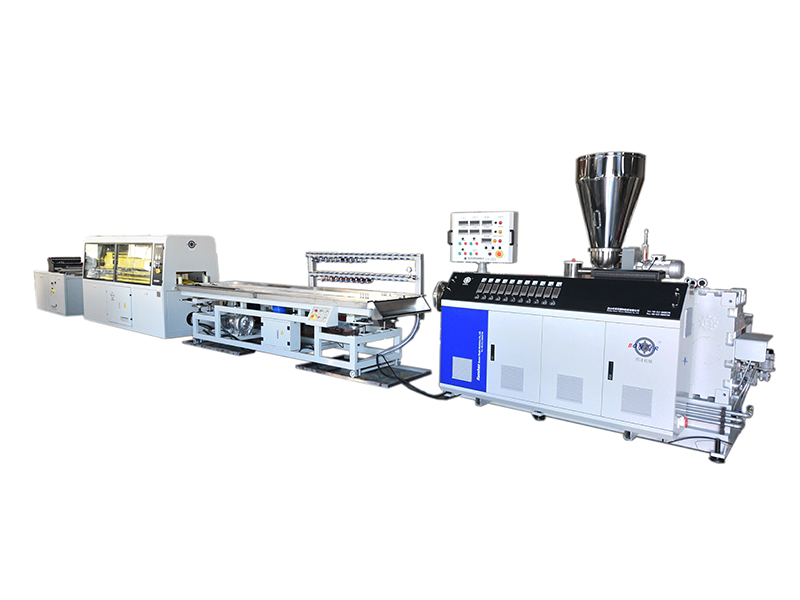
Translating abstract business goals into technical specifications is a critical engineering challenge. Output capacity, measured in kilograms per hour, dictates the physical size and power requirements of the entire system.
To determine the exact capacity required, calculate your target annual tonnage and divide it by actual operational hours. Furthermore, you must factor in the Overall Equipment Effectiveness. This metric accounts for real-world scenarios like planned maintenance, mold changes, and unexpected downtime.
For instance, a facility aims to produce 2,000 tons annually. They operate 300 days a year, 16 hours a day, with an equipment effectiveness rate of 80 percent. The required output is roughly 520 kilograms per hour. In this scenario, you need an extruder rated for 550 to 600 kilograms per hour. A robust PVC pipe machine equipped with a high-torque gearbox will maintain this comfortable operational rhythm without overstraining the motor.
Extruders are engineered to operate optimally within specific output ranges. Small-scale lines process 150 kilograms per hour, while heavy-duty industrial setups easily exceed 1,000 kilograms per hour. Selecting the correct machinery requires avoiding two common engineering errors: over-speccing and under-speccing.
Over-speccing results in wasted electrical energy and poor plasticization. Running a massive extruder at excessively low speeds prevents the screw from generating adequate shear heat. In contrast, under-speccing forces the machinery to run at maximum capacity constantly. This relentless strain accelerates mechanical wear on the gearbox and thrust bearings, exponentially increasing the risk of catastrophic failure.
The physical dimensions of the product—specifically the outer diameter and wall thickness—dictate the factory footprint and configuration of the entire extrusion setup.
Pipes within this narrower range serve primarily as electrical conduits, telecommunications casing, and small-scale residential plumbing. Because the material volume per meter is exceptionally low, a standard single-strand line wastes the extruder's full melting capacity. This leads to thermal inefficiencies and higher energy costs.
To counteract this, engineers deploy dual-strand or four-strand multi-cavity die heads. These advanced systems use a single extruder to produce two or four profiles simultaneously. This configuration maximizes output without requiring a massive footprint, significantly reducing the manufacturing cost per meter.
Medium to large profiles are engineered for municipal water supply, underground sewage, and heavy agricultural irrigation networks. Producing these robust products requires a fundamentally different equipment scale.
Large diameter production necessitates massive die heads capable of managing immense internal melt pressures. Moreover, thick-walled products retain significant thermal mass. Heavy-duty plastic pipe extrusion equipment demands extended vacuum calibration and long water cooling tanks. A large diameter line often requires 20 to 30 meters of downstream cooling length just to ensure the core wall is fully solidified before reaching the cutter.
When configuring a manufacturing facility, understanding the specific mechanics of your melting and mixing equipment is paramount. For processing dry powder blends, industry standards strictly dictate the use of a twin screw extruder rather than a single screw configuration.
The fundamental difference between these two technologies lies in material handling capabilities. Single screw extruders rely heavily on friction against the barrel wall to move and melt polymer pellets. This works exceptionally well for polyethylene. However, polyvinyl chloride powder is highly heat-sensitive. It is prone to rapid thermal degradation if subjected to excessive friction.
A twin-screw system operates on a positive displacement principle. The intermeshing of the two screws forces the powder forward at a consistent rate. This provides superior mixing of additives, such as stabilizers and calcium carbonate, while maintaining precise temperature control. It prevents the material from burning and ensures a homogenous, high-quality melt.
Manufacturers must choose between conical and parallel designs based on specific formulation requirements. Conical designs feature screws that taper from a wide feed zone to a narrow discharge zone. This geometry naturally compresses the material, building high pressure at the die head. They offer excellent shearing at lower speeds, making them ideal for formulations containing high levels of calcium carbonate filler.
Parallel designs maintain a uniform diameter throughout the barrel. They are capable of higher rotational speeds and feature longer length-to-diameter ratios. Parallel extruders are generally preferred for high-speed, high-volume production scenarios where extended residence time is required for complex compounding.
Operational longevity is directly tied to the metallurgy of core components. Dry powder blends are highly abrasive. Standard nitrided steel screws often wear down within a single year under heavy production schedules. To mitigate this, industrial-grade operations specify bimetallic screws and barrels. Coating the wear surfaces with specialized tungsten carbide alloys extends the operational lifespan of the components to three to five years.
The efficiency of the primary melting unit is ultimately irrelevant if downstream machinery cannot handle the volume or dimensions of the extruded melt. Properly sizing these components prevents bottlenecks and maintains strict wall thickness tolerances.
Once the molten plastic exits the die head, it enters the vacuum calibration tank. This component uses negative atmospheric pressure to pull the soft plastic against a sizing sleeve, instantly freezing the outer diameter. The length and cooling capacity of these tanks must align mathematically with the wall thickness and line speed.
For thin-walled conduit profiles, a single 6-meter vacuum tank suffices. In contrast, for large-diameter, thick-walled pressure pipes like 315mm SDR 11, the core retains heat significantly longer. In these scenarios, engineers install extended vacuum tanks followed by multiple supplementary water spray cooling sections to prevent ovality issues and dimensional warping.
The haul-off unit pulls the continuous profile through the cooling tanks at a strictly synchronized speed. Small profiles up to 63mm typically require a two-caterpillar haul-off. Medium profiles from 75mm to 250mm need three to four caterpillars to prevent slippage. Heavy-wall profiles from 315mm to 630mm demand six to eight caterpillars to distribute grip pressure evenly and prevent crushing the product.
Downstream cutting must be equally precise. Standard pneumatic saw cutters are effective for smaller profiles. However, planetary cutters are mandatory for medium to large diameter thick-walled products. Planetary cutters revolve around the pipe, providing a clean, swarf-less cut while simultaneously chamfering the edge. This beveling action is a critical step for subsequent socket jointing.
The specific chemical formulation of the polymer dictates the thermal and mechanical requirements of your production setup. Failing to match machine specifications to the material type inevitably results in catastrophic production failures.
This is the standard rigid material used globally for cold water supply, drainage, and sewage. A standard extrusion setup with standard temperature control zones and bimetallic screws is highly effective. The processing window is relatively wide, making it the most forgiving material to extrude.
Chlorinated variants are engineered to withstand high temperatures, making them the primary choice for industrial chemical transport and residential hot water plumbing. However, the addition of chlorine makes the material highly heat-sensitive and incredibly corrosive when molten. Running this material through a standard die causes acidic off-gassing that pits the steel within weeks. Processing requires heavily chrome-plated die heads, specialized low-shear screw geometries to prevent burning, and enhanced internal screw cooling systems.
Representing the cutting edge of extrusion technology, oriented profiles undergo a process of biaxial molecular orientation. This exponentially increases structural strength and impact resistance, allowing for much thinner walls. Producing this requires an entirely different downstream setup. After standard extrusion, the profile enters a highly specialized stretching and expansion chamber under precise thermal conditions to align the polymer molecules.
Procuring industrial machinery is a capital-intensive decision. High-intent buyers must shift their focus from the initial sticker price to the Total Cost of Ownership over a multi-year operational horizon.
The upfront cost of a pipe making machine typically accounts for less than 20 percent of its total lifecycle cost. Raw material consumption, electricity, maintenance, and labor consume the remaining 80 percent. When evaluating machinery, scrutinize the energy efficiency of the primary motors. Permanent magnet synchronous motors reduce electricity consumption by up to 15 percent. Additionally, machines equipped with high-precision PLC controls and gravimetric dosing systems minimize overweight products and startup scrap. This directly impacts your bottom line.
A reliable machinery manufacturer acts as a long-term technical partner rather than a transactional vendor. Key evaluation criteria should include component traceability, ensuring gearboxes and PLCs are sourced from globally recognized brands for local replacement availability. Furthermore, verify customization capabilities. The engineering team must tailor the equipment footprint to match your specific factory floor layout and regional utility connections.
A successful extrusion setup requires meticulous technical planning. You must balance ambitious output goals with the realities of material science and factory floor space. Matching these specific pillars ensures the production of higher quality products while simultaneously lowering daily operational costs. This strategic approach ultimately accelerates your financial return. Ready to upgrade your manufacturing capability? Explore high-performance solutions and match your exact specifications by visiting KS Bonzer to find the ideal equipment for your next project.
Generally, no. The two polymers require fundamentally different processing technologies. PVC requires a twin-screw extruder to handle dry powder and prevent thermal degradation through positive displacement. PE requires a single-screw extruder designed to melt pellets via friction. Furthermore, the die head designs, cooling tank configurations, and screw geometries are entirely incompatible between the two materials.
Floor space requirements are dictated entirely by the target diameter. A small-diameter electrical conduit line measuring 16mm may only require 15 to 20 meters in total length. Conversely, a large-diameter municipal water line measuring 630mm can easily exceed 40 to 50 meters due to the necessity of extended vacuum calibration and multiple supplementary water cooling tanks.
The lifespan is heavily dependent on the calcium carbonate filler ratio in your specific formulation. Standard nitrided screws processing highly filled materials may show significant wear within 12 to 18 months. However, investing in high-quality bimetallic screws with tungsten carbide coatings extends the operational lifespan to 3 to 5 years before replacement is required.
A dual-strand configuration allows a manufacturer to double the output of small-diameter profiles, such as 16mm to 32mm, using only a single extruder and a specialized multi-cavity die head. This setup significantly reduces the required factory floor space, lowers overall energy consumption per kilogram produced, and requires less initial capital investment compared to purchasing and operating two completely separate extrusion lines.
The ideal temperature profile varies based on the specific chemical formulation and filler content. Generally, barrel temperatures range from 170 to 195 degrees Celsius across the various heating zones. Utilizing precise PID controllers is mandatory to maintain these exact temperatures, preventing the heat-sensitive powder from degrading or burning inside the barrel.
Rough or brittle surfaces typically stem from poor plasticization, incorrect temperature settings, or excessive moisture trapped in the raw powder blend. Adjusting the screw rotational speed, increasing the barrel temperature slightly, and ensuring the vacuum degassing system on the extruder is functioning optimally will usually resolve surface finish and brittleness issues.


