
English ![]()

Views: 0 Author: Site Editor Publish Time: 2026-09-07 Origin: Site
Optimized Material Yield: Modern extrusion systems utilize gravimetric dosing and synchronized haul-off mechanisms. This maximizes hourly output while virtually eliminating expensive resin waste.
Thermal and Electrical Efficiency: Upgraded motor configurations and specialized screw geometries reduce extruder torque. Facilities often see power consumption drop by up to 30 percent.
Process Automation: Centralized control systems reduce reliance on manual adjustments. Smart sensors handle the micro-adjustments, lowering labor-related expenses and operator error.
Material Specificity: Dedicated machinery ensures proper melt homogenization for high-density polyethylene. This prevents structural defects and opens doors to lucrative infrastructure contracts.
Operational Agility: Modular die heads and automated calibration units execute rapid changeovers between different pipe diameters. Factories can support diverse client requirements with minimal downtime.
Global infrastructure development requires massive volumes of plastic piping. Water management, agricultural irrigation, and telecommunications rely heavily on durable conduits. Manufacturers face increasing pressure to scale production rapidly while maintaining strict dimensional tolerances. On the factory floor, legacy manufacturing setups often struggle to meet these demands. Older equipment typically suffers from high energy consumption, inconsistent material melting, and frequent mechanical downtime. Operators are left guessing heater band settings, and these operational inefficiencies directly erode profit margins.
Current industry trend analysis reveals a critical shift in the plastics manufacturing sector. Global resin prices remain volatile, and municipal contracts now demand tighter verifiable quality data. Consequently, facilities are abandoning volume-at-all-costs strategies. The market is moving aggressively toward precision-yield models. Upgrading machinery is no longer just about adding raw capacity. It is fundamentally about material optimization, reducing carbon footprints, and stabilizing unit economics.
Implementing a modern pipe extrusion line provides a highly engineered solution to these exact bottlenecks. Contemporary systems operate on closed-loop feedback mechanisms. The machinery constantly monitors internal melt pressure, barrel temperatures, and line speed. It makes real-time micro-adjustments to maintain exact product specifications. Faster extrusion speeds equate to higher daily yields. Simultaneously, a drastic reduction in scrap rates means a higher percentage of raw material converts directly into sellable inventory.
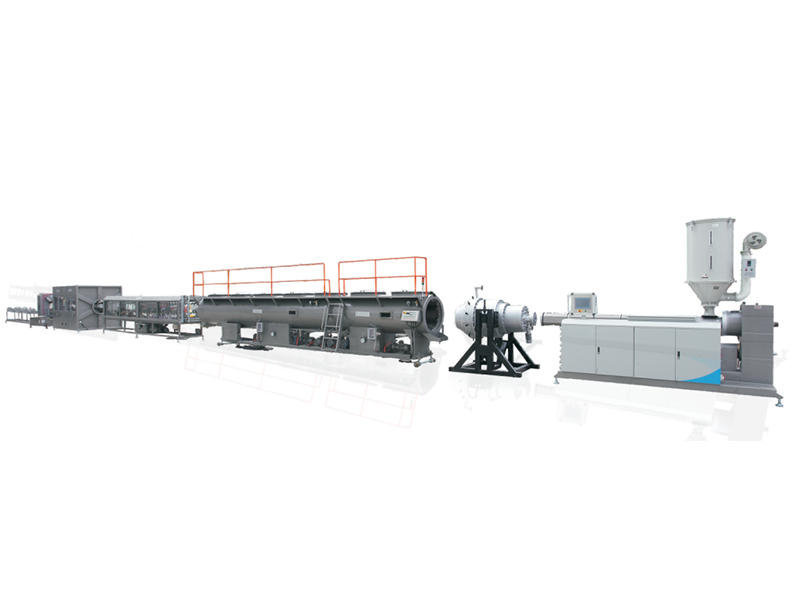
To understand how overall facility efficiency improves, we must examine the constituent parts of the machinery. Each module in the sequence plays a specific role in stabilizing the polymer melt and forming the final product seamlessly.
The extruder acts as the primary engine of the production line. Its efficiency is largely dictated by the screw design and the length-to-diameter ratio. Modern extruders utilize optimized ratios, often 33:1 or 38:1 for polyolefins. This provides a longer residence time for the polymer. The extended heating zone ensures a highly uniform melt without requiring excessive temperatures that degrade the plastic.
Advanced barrier screw designs feature secondary flights that physically separate the melted polymer from the solid pellets. This separation reduces internal friction. By managing friction mechanically rather than relying solely on electrical heater bands, the system prevents material degradation. Operators spend less time purging degraded plastic from the barrel and more time running profitable shifts.
Once the molten polymer exits the die head at temperatures exceeding 200 degrees Celsius, it must be sized and cooled immediately to prevent sagging. Vacuum calibration tanks achieve this by pulling the soft pipe against a sizing sleeve using precise negative pressure. Automated vacuum controls ensure perfect external dimensions. This is absolutely critical for pipes that must fit standard commercial fittings without leaking.
Following calibration, high-speed water cooling tanks rapidly strip away the thermal energy. Modern lines utilize multi-stage spray cooling rather than simple immersion water baths. Spray cooling penetrates the boundary layer of heat surrounding the pipe, extracting thermal energy much faster. The entire extrusion line can operate at significantly higher speeds without risking warpage.
The haul-off unit pulls the cooled pipe through the system. Any variation in pulling speed will immediately alter the wall thickness of the pipe, leading to rejected batches. Modern haul-off machines are equipped with multi-caterpillar tracks driven by independent servo motors. These motors provide continuous traction, ensuring the pulling speed perfectly matches the extruder output.
Finally, planetary cutting machines provide precise, dust-free cuts. By rotating a blade around the circumference of the moving pipe, the cutter creates a perfectly flat edge with a defined chamfer. This eliminates the need for secondary manual processing. The pipe moves directly from the extrusion line to the packaging or belling station.
High-density polyethylene has become the dominant material for municipal water grids, gas distribution, and heavy-duty agricultural irrigation. Its inherent properties make it superior to traditional materials in subterranean applications. However, processing this material efficiently requires specific mechanical capabilities that older setups simply lack.
Standard extrusion machines often fail when processing tough polyolefins. High-density polyethylene has a high melt viscosity and strongly resists flow when melted. Pushing this highly viscous material through a die requires immense mechanical force. Therefore, a specialized HDPE pipe extrusion line is engineered with reinforced gearboxes and high-torque motors capable of handling continuous physical loads without burning out.
Precise thermal management is non-negotiable. If the temperature is too low, the material will not homogenize. If it is too high, the polymer chains degrade. Dedicated lines utilize advanced temperature controllers. When the operator sets the target to 210 degrees Celsius, the system holds it within a single degree.
Investing in purpose-built machinery directly resolves common production defects like melt-fracture. Below is a direct comparison of how modern systems outperform legacy setups on the factory floor:
| Performance Metric | Legacy Extrusion Lines | Modern High-Efficiency Lines |
|---|---|---|
| Energy Consumption | High power draw, inefficient AC motors | Up to 30% lower via permanent magnet motors |
| Material Waste (Scrap) | 5% to 8% due to manual calibration | Less than 1% via gravimetric dosing |
| Changeover Time | Several hours to a full shift | Rapid adjustments with modular die heads |
| Quality Control | Visual inspection, manual adjustments | Real-time Siemens PLC closed-loop feedback |
Furthermore, energy consumption represents one of the highest variable costs in plastic manufacturing. Upgrading an extrusion line yields immediate, measurable reductions in electrical usage through a combination of mechanical and electrical innovations.
Traditional extrusion lines rely on standard asynchronous motors. These operate inefficiently at lower speeds or partial loads. In contrast, modern systems integrate permanent magnet synchronous motors. These drives maintain high torque density and efficiency across a wide range of operating speeds. Empirical data from recent machinery upgrades indicates that advanced motor technology can drop energy consumption down to roughly 0.28 to 0.32 kWh per kilogram of output.
Extruder torque is the rotational force required to turn the screw against the resistance of the melting plastic. High torque consumes massive amounts of electricity and accelerates physical wear on the gearbox. Advanced extrusion lines mitigate this through heavy-duty insulation technologies and optimized barrel grooving. By pre-heating the feed section efficiently, the machine reduces the mechanical resistance of the polymer. This extends the lifespan of the mechanical components and stabilizes the power draw of the entire facility.
The integration of digital controls has transformed extrusion from an operator-dependent craft into a highly predictable process. Automation allows facilities to maintain peak efficiency with minimal manual intervention.
Modern lines utilize centralized programmable logic controllers, typically featuring intuitive touch-screen interfaces from top-tier brands. These systems aggregate data from dozens of sensors placed along the extrusion line. A single operator monitors melt pressure, zone temperatures, cooling water flow, and haul-off speeds from one station. If a parameter deviates from the established tolerance, the system automatically compensates. It will slightly increase the haul-off speed if the pipe weight begins to trend upwards.
Because material costs account for the vast majority of a pipe price, over-extruding is a costly inefficiency. Gravimetric dosing systems solve this by continuously weighing the raw material as it enters the extruder. The system communicates directly with the haul-off unit, adjusting the line speed in real-time to guarantee the exact required weight per meter. This precision prevents overweight pipes and yields massive raw material savings annually.
Original equipment manufacturers and large-scale contractors frequently demand varying pipe specifications. A factory ability to pivot quickly dictates its competitiveness in the market.
Older machines required hours to change die heads and calibrate cooling tanks for a new pipe diameter. Modern die heads are designed for rapid changeovers. Utilizing automated calibration sleeves and quick-release clamping mechanisms, a facility can switch from producing 20mm residential conduit to 110mm municipal water pipes with minimal downtime. In addition, multi-layer co-extrusion technology allows manufacturers to add colored identification stripes or anti-microbial inner layers seamlessly. Secondary smaller extruders feed directly into a specialized die head, bonding the layers perfectly during the melt phase.
Transitioning to high-efficiency manufacturing requires careful capital planning. Specifically, selecting the correct machinery ensures the fastest possible return on investment.
Before purchasing, facility managers must calculate their required capacity. Overestimating leads to purchasing oversized equipment that runs inefficiently at partial loads. Analyze your historical sales data and project future volumes. If your primary market is standard residential plumbing, a line optimized for 16mm to 63mm diameters is ideal. If you are targeting municipal infrastructure, you need a high-performance HDPE pipe extrusion line capable of handling 160mm to 315mm, or even up to 1200mm heavy-duty pipes.
The physical machinery is only half of the investment. The manufacturer support network is the other. Choose a reliable supplier that offers comprehensive installation, on-site operator training, and rapid spare parts delivery. Strong after-sales support ensures your factory maintains high efficiency long after the initial commissioning phase.
Upgrading to a modern pipe extrusion system fundamentally transforms factory output. By integrating advanced barrier screws, multi-stage cooling, and servo-driven haul-offs, manufacturers can slash energy costs and virtually eliminate raw material waste. Smart automation and gravimetric dosing keep production running continuously, removing the guesswork from daily operations.
In today highly competitive plastic manufacturing landscape, operational efficiency is a strict necessity for survival. Better machinery directly increases your daily profits, ensures your products meet rigorous engineering standards, and accelerates your time-to-market.
Evaluate your current factory capacity and operational bottlenecks today. By partnering with a trusted equipment provider and upgrading to specialized pipe extrusion equipment from KS Bonzer, you can future-proof your production facility and secure more lucrative contracts in the growing global infrastructure market.
With proper routine maintenance and the use of high-quality internal components, a modern extrusion line can reliably operate for 10 to 15 years. Many robust systems run even longer before requiring a major mechanical overhaul or replacement.
The footprint depends heavily on the maximum pipe diameter being produced. A standard line for small conduits might require 15 to 20 meters in length. Conversely, a large-diameter municipal pipe line producing 315mm to 630mm pipes will typically require 40 to 60 meters of linear factory floor space to accommodate the extended vacuum and cooling tanks.
Thanks to optimized barrier screw designs, advanced multi-stage spray cooling, and synchronized servo motors, modern lines can achieve 30 to 50 percent higher line speeds compared to legacy equipment. This significantly boosts daily output without compromising pipe wall integrity.
For a facility running standard shifts, the return on investment typically ranges from 12 to 24 months. This rapid payback is driven primarily by the drastic reduction in raw material waste via gravimetric dosing, combined with 20 to 30 percent savings on electrical energy consumption.
While technically possible with significant and time-consuming modifications, it is highly inefficient. These materials have vastly different melting behaviors, requiring different screw geometries, motor torques, and cooling setups. It is always recommended to use a dedicated line for each material type to maintain peak efficiency.
A gravimetric dosing system continuously weighs the raw resin as it enters the feed throat. It automatically adjusts the haul-off speed and extruder rotation in real-time to maintain the exact target pipe weight per meter. This eliminates overweight pipes, saving up to 5 percent in raw material costs annually.
Standard upkeep includes regular lubrication of the gearbox and haul-off tracks. Operators must routinely clean the die head to prevent carbon buildup. Additionally, checking electrical heater bands for consistent output and periodically calibrating the pressure sensors ensures accurate data reporting to the main control system.


