
English ![]()

Views: 0 Author: Site Editor Publish Time: 2026-07-20 Origin: Site
Investing in a PVC profile extrusion line represents a high-stakes capital expenditure for any manufacturing facility. You are not simply buying a standalone machine. You are acquiring a synchronized, continuous process. Within this process, thermal control and mechanical precision must perfectly align. Success extends far beyond merely melting polymer pellets. You must consistently achieve tight dimensional tolerances. Operators must also manage the unique thermal sensitivities of polyvinyl chloride. Maximizing Overall Equipment Effectiveness (OEE) while strictly controlling energy costs remains your ultimate operational goal. This guide moves beyond basic textbook definitions. We map out the actual mechanical processes you will encounter on the factory floor. You will discover real-world failure points and learn practical ways to mitigate them. Furthermore, we provide a robust framework for evaluating commercial equipment options. By understanding this complex thermodynamic system, you can make highly informed procurement decisions.
System Synergy: A PVC profile extrusion line relies heavily on downstream calibration and auxiliary equipment; the extruder alone only dictates 50% of the final product quality.
Material Sensitivity: Because PVC is highly sensitive to heat and shear, twin-screw extruders are the industry standard for rigid profile production to prevent material degradation.
Real-World Reliability: Long-term profitability depends on managing specific wear factors, primarily screw/barrel abrasion and vacuum pump failures in the calibration table.
Evaluation Focus: When shortlisting vendors, prioritize automation openness (PLC compatibility), energy-to-output ratios, and localized spare parts availability over baseline pricing.
Understanding the distinct phases of the production line is critical. This knowledge helps you identify hidden production bottlenecks. It also clarifies your specific equipment requirements. A modern PVC profile extrusion line functions as a unified ecosystem. If one section fluctuates, the entire process suffers.
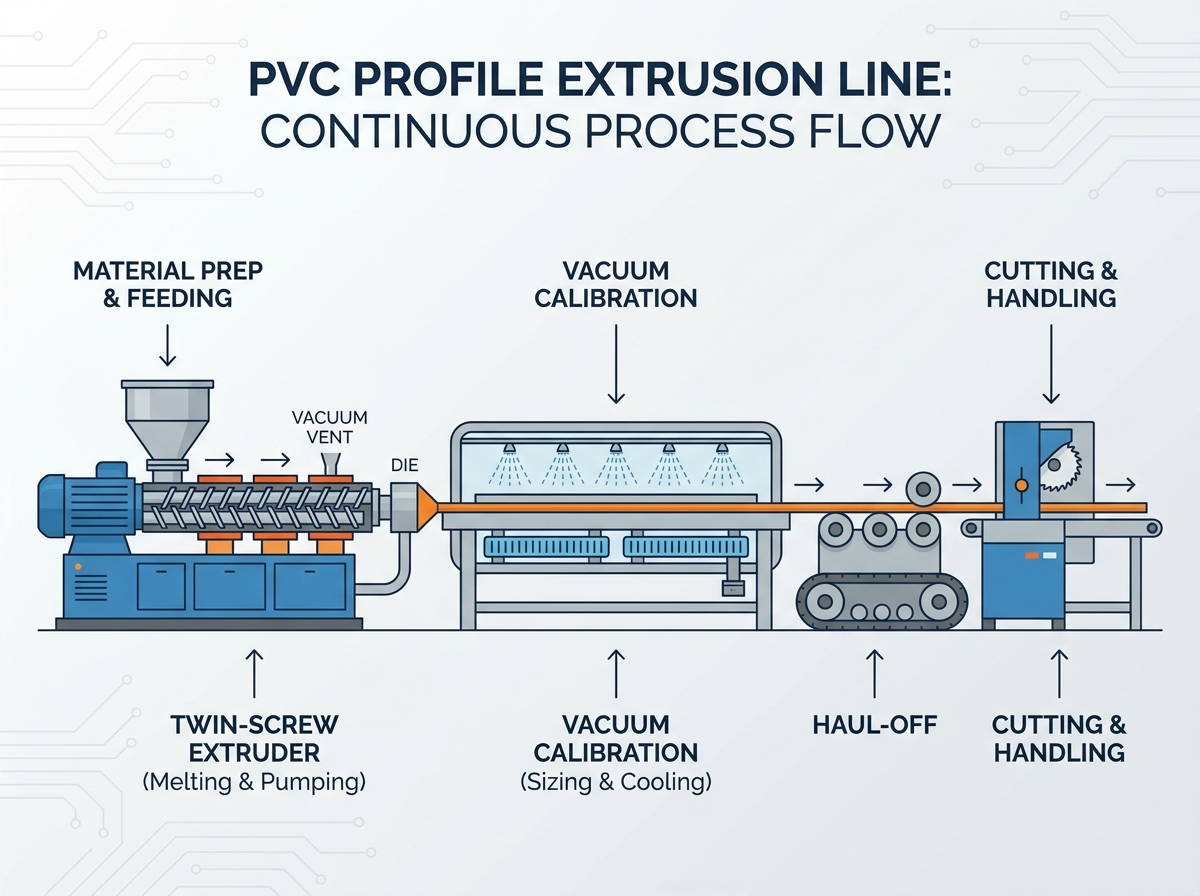
The manufacturing journey begins long before plastic enters the extruder barrel. High-speed heating and cooling mixers create the initial PVC dry blend. They disperse vital additives, heat stabilizers, and mineral fillers evenly throughout the resin. Once mixed, feeding this powder reliably becomes the next challenge. You must choose between gravimetric and volumetric dosing systems. Volumetric dosing measures material purely by volume. Gravimetric dosing continuously measures the material by actual weight. Experts strongly prefer gravimetric dosing. It actively prevents material surging inside the hopper. Precise, weight-based feeding remains mandatory. It guarantees strict dimensional stability in the final profile.
This phase aggressively melts and transports the polymer. Conical or parallel twin-screw extruders dominate the rigid PVC industry. Polyvinyl chloride possesses extremely high thermal sensitivity. It degrades rapidly under excessive shear stress. Single-screw machines often generate too much friction. Twin-screw systems offer a low-shear alternative. They provide a gentle, positive pumping action. This tightly controls the thermal history of the melt. The barrel features specific heating and cooling zones. These zones maintain strict temperature profiles along the screws. Additionally, vacuum degassing units extract trapped moisture. They remove gaseous volatiles before the plastic exits the system.
The die head meticulously shapes the molten plastic. Tooling engineers design these dies to ensure smooth polymer flow. They must eliminate all internal dead zones. Stagnant PVC will burn and degrade rapidly inside the die. Once shaped, the hot melt enters the vacuum calibration table. This critical step permanently freezes the profile into its final dimensions. The table relies on precise water cooling. Vacuum sizing blocks hold the soft plastic firmly against the cold calibration tooling. This physical constraint ensures the profile matches the required geometric tolerances perfectly.
The extruded plastic needs continuous, steady pulling. Caterpillar haul-off units provide this necessary traction. They maintain constant line tension. They grip the material firmly but gently through continuous rubber belts. This careful handling prevents crushing delicate, hollow window or door profiles. Finally, synchronized cutting systems divide the continuous extrusion into saleable lengths. Facilities typically use traversing saws or high-speed guillotine cutters. Advanced systems use encoder feedback to guarantee precise cut lengths. Automated tipping tables then gently drop the final pieces into collection bins. They prepare the finished product for immediate packaging.
Operational profitability depends entirely on minimizing unplanned downtime. Evaluating a new system means actively looking for mechanical vulnerabilities. You need to anticipate failures before they halt your production floor.
PVC burns exceptionally easily. If the residence time inside the barrel extends too long, the material rapidly degrades. Dark yellow streaks in your profile clearly indicate early burning. Evaluating the vendor's screw geometry matters immensely. You must also ensure cooling fan redundancy. If one barrel cooling fan fails, localized temperatures spike rapidly. Best practices dictate keeping spare fans nearby. Operators must monitor barrel zone temperatures constantly to prevent catastrophic material degradation.
Rigid PVC formulations often contain heavy calcium carbonate fillers. This mineral additive acts as a harsh abrasive. It relentlessly scours the internal steel surfaces. Over time, the screw flights wear down. Pumping efficiency drops dramatically as clearance gaps increase. Assess the metallurgical treatments offered by machinery vendors carefully. Look for thick bimetallic coatings on the screws and barrels. These hardened tungsten-carbide alloys resist severe abrasion. They extend the operational lifespan of your core processing equipment significantly.
The calibration table frequently causes costly dimensional failures. Liquid ring vacuum pumps wear out over time. Internal water channels inside the sizing tooling become blocked by mineral scale. When vacuum pressure drops abruptly, the profile warps. It pulls away from the cold calibration sleeve. Regular preventative maintenance of all vacuum pumps is vital. Use closed-loop, chemically treated water. This prevents damaging scale buildup inside your expensive brass or aluminum tooling.
You must transition from understanding mechanics to comparing actual market options. Buying capital equipment requires a strict focus on measurable outcomes. You want long-term efficiency, not just raw motor power.
Do not just look at maximum throughput capacity. Throughput means little if the machine wastes expensive electricity. Measure the specific energy consumption carefully. Look for the lowest kilowatt-hours required per kilogram of output (kWh/kg). Drive technology plays a massive role here. Standard AC motors consume more power over their lifecycle. Permanent magnet synchronous motors (PMSM) offer superior energy efficiency. They provide significant long-term power savings. They also deliver tighter, more responsive speed control under varying loads.
Avoid proprietary, locked black-box controllers at all costs. They lock you into single-vendor support networks. Demand open-architecture Programmable Logic Controllers (PLCs) instead. Systems from Siemens, B&R, or Allen-Bradley offer universal familiarity. Your local technicians can troubleshoot them easily without factory intervention. Consider modern data logging capabilities. Advanced controllers store detailed recipe management parameters. They log historical temperature trends for predictive maintenance. They ensure complete digital traceability for every batch you produce.
| Evaluation Dimension | Standard Configuration | Advanced Configuration |
|---|---|---|
| Material Dosing System | Volumetric (Time and volume based) | Gravimetric (Weight based, real-time adjustments) |
| Main Drive Motor Type | Standard AC Motor | Permanent Magnet Synchronous Motor (PMSM) |
| Controller Architecture | Proprietary closed-loop system | Open-architecture PLC (Siemens, B&R) |
| Barrel Metallurgy | Standard Nitrided Steel | Bimetallic Alloy Coating |
An extrusion line will fail to scale if its auxiliary ecosystem remains under-specified. The main extruder usually gets all the attention. However, the supporting equipment does the heavy lifting.
High-speed profile extrusion demands aggressive, continuous heat removal. Centralized chillers are absolutely non-negotiable. They must provide consistent, low-temperature water to the calibration tables year-round. Closed-loop water treatment is equally critical. Untreated city water leaves thick mineral scale inside tiny tooling channels. This scale acts as a powerful thermal insulator. It blocks essential heat transfer. Your line speed will drop dramatically as cooling efficiency degrades.
Scrap generation happens during every startup and shutdown sequence. Managing this scrap impacts your material costs heavily. Inline crushers and pulverizers process defective profiles on the spot. They turn solid scrap back into usable powder. You must re-introduce this regrind carefully. Too much regrind severely compromises the structural impact strength of the new profile. Use precise auxiliary dosing equipment to blend regrind smoothly with virgin material.
To integrate auxiliary systems effectively, follow these procedural steps:
Audit your current electrical infrastructure to ensure sufficient amperage for large industrial chillers.
Install heavy-duty filtration units on all closed-loop water cooling circuits.
Set up a dedicated quality testing protocol for defining maximum regrind mixing ratios.
Common mistakes when specifying auxiliary systems include:
Underestimating the required chilling capacity by ignoring peak summer ambient temperatures.
Using untreated tap water directly in calibration tooling, leading to rapid scaling.
Failing to dust-extract regrind materials, which causes visible surface defects on final profiles.
You need a structured approach to vendor selection. This logical approach minimizes your initial capital risk. It ensures the equipment actually delivers on its promises upon arrival.
Never skip the formal Factory Acceptance Testing phase. You must demand a full-speed, continuous run before the equipment ships. Use your specific material formulation during this test. Mount and test your exact custom tooling. A machine might run perfectly on the vendor's forgiving standard PVC blend. It might fail entirely on your heavily filled custom recipe. Validate everything at the factory floor before signing the final approval.
Industrial hardware eventually breaks. Evaluating a vendor means evaluating their localized support footprint. Ask if they deploy field-service technicians in your region. Check their historical response times. Ask about the off-the-shelf availability of critical wear parts. You need immediate access to ceramic band heaters, thermocouples, and replacement vacuum pumps. Waiting weeks for a proprietary part shipped from overseas destroys your production schedule and harms your customer relationships.
A PVC profile extrusion line represents a highly complex, integrated thermodynamic system. It is not merely a mechanical conveyor pushing hot plastic. Every phase dictates the direct success of the next. Successful procurement always balances initial machine costs against long-term realities. You must weigh energy efficiency, metallurgical durability, and localized technical support carefully. We encourage all buyers to audit their current utility infrastructure immediately. Check your available power feeds and cooling capacities. Define your precise material formulations clearly. Complete these crucial steps before you initiate serious vendor discussions. Thorough preparation guarantees a smooth implementation and decades of profitable production.
A: Single-screw extruders rely heavily on friction to melt plastics. This high shear generates excess heat, which can easily burn rigid PVC. Twin-screw extruders provide positive material displacement and gentle melting. This low-shear environment controls the melt temperature, making twin-screw technology mandatory for producing rigid UPVC profiles safely.
A: Floor space depends heavily on your required cooling duration. However, a standard line stretching from the main extruder to the final tipping table typically requires 20 to 30 meters in length. This measurement excludes upstream material mixing areas and downstream packaging zones.
A: Lifespan depends primarily on the abrasive filler content, like calcium carbonate, in your PVC formulation. Standard components may last 10,000 to 20,000 operational hours before requiring significant refurbishment. Using high-quality bimetallic coated components extends this lifespan considerably, even when processing highly filled material blends.


